The Missing Layer in Enterprise AI
Every big company I talk to now says some version of the same thing:
"We rolled out Copilot. We're building a data lake.
Why does everything still feel manual?"
They're not imagining it.
Most of the work is still being done by people acting as the missing layer between systems.
They have SAP or Oracle NetSuite for finance, Workday for people, Salesforce for customers, a procurement system for spend, some planning tool, and a data warehouse on top. On slides, it looks impressive. In reality, it still works only because smart people sit in the middle and hold it together.
Vendors pretend that if you add Copilot on top, this will somehow go away. It won't.
Copilot lives inside tools. The real problem lives between them.
That gap is what I mean by an intelligence layer.
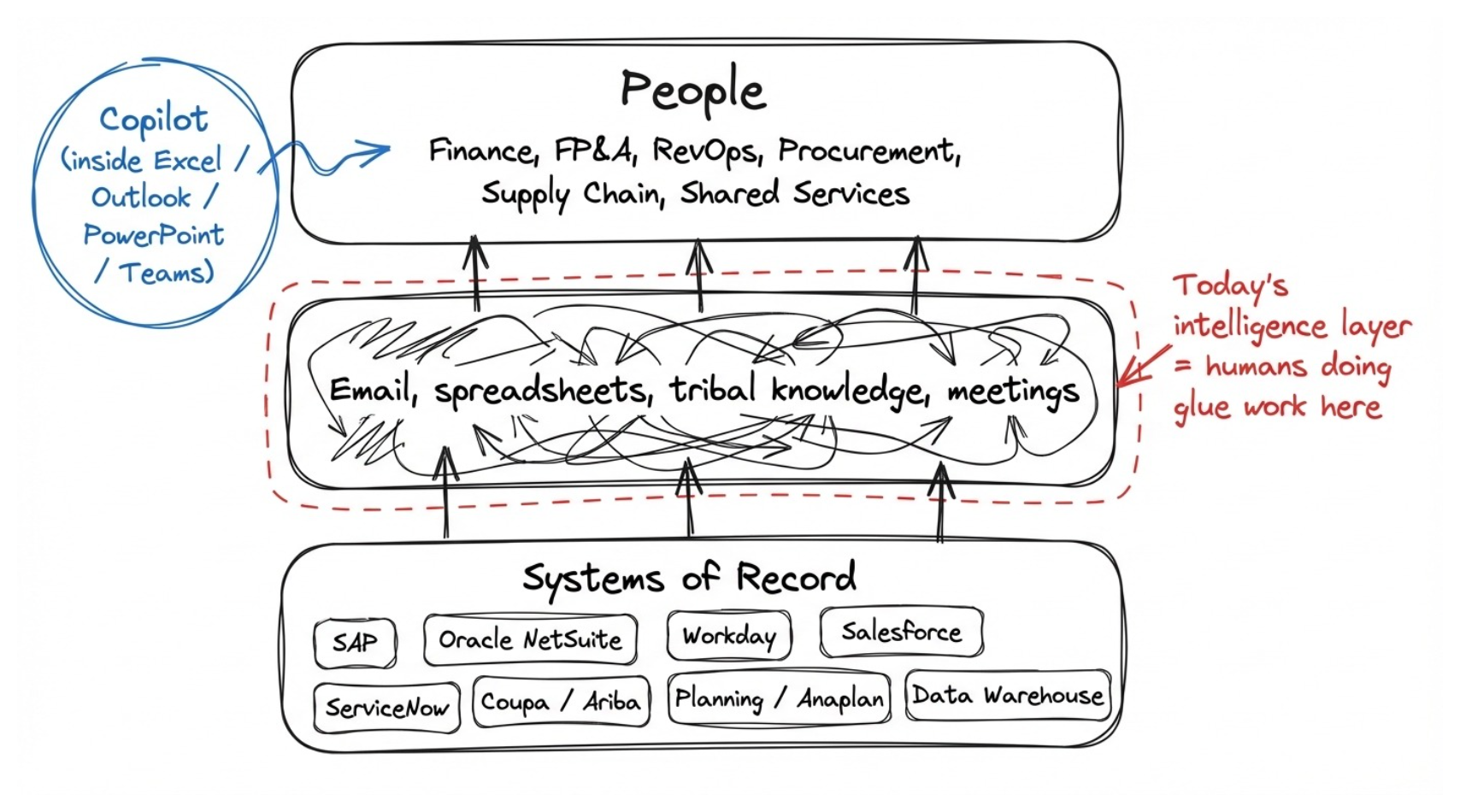
People Are the Current Intelligence Layer
Right now the architecture in most enterprises looks like this:
- •Bottom: systems of record
SAP, NetSuite, Oracle, Workday, Salesforce, ServiceNow, Coupa, Ariba, Anaplan, your warehouse, etc. - •Top: people
Finance, FP&A, RevOps, Procurement, Supply Chain, Shared Services.
They know how work actually gets done, where data is wrong, and which exception rules everyone quietly follows. - •Middle: email, spreadsheets, tribal knowledge, and meetings.
The "intelligence layer" today is those people:
- •They know that a Sales Order in SAP and an Opportunity in Salesforce are the same thing economically, even if structures differ.
- •They know which vendor is always 12% over contract price but everyone keeps using them.
- •They know which lines in the GL are garbage and have to be mentally adjusted.
- •They know which approval chains are real and which ones are political theater.
When something important happens - a big variance, a stuck invoice, a suspicious PO, a customer screaming about billing - it's never "the system" that understands it. It's a person.
That's the part I'm trying to turn into software.
What Copilot Actually Fixes (and What It Can't)
Copilot is useful. It just solves a smaller problem than people assume.
What it does well:
- •Inside Excel, it helps clean data, generate formulas, and describe what's in a sheet.
- •Inside Outlook and Teams, it drafts responses and summaries.
- •Inside Word/PowerPoint, it turns notes into documents and decks.
- •With the finance flavors, it can help with spreadsheet-level variance checks and commentary.
If your world is "I already have a clean model in Excel, help me work faster on it," Copilot is great.
But think about how most important work actually happens:
- •A variance isn't a single sheet; it's data scattered across ERP, planning, procurement, HR, warehouse, and CRM that gets glued into a sheet.
- •A stuck deal isn't a paragraph; it's an object moving between CRM, CPQ, ERP, billing, collections, and maybe support.
- •A spend problem isn't a pivot; it's thousands of POs and invoices across plants, vendors, SKUs, projects, and years.
Copilot helps you talk about work that has already been assembled.
It does not run the work.
That's the distinction that matters.
What an Intelligence Layer Is (In Plain Language)
Forget buzzwords. Picture this instead.
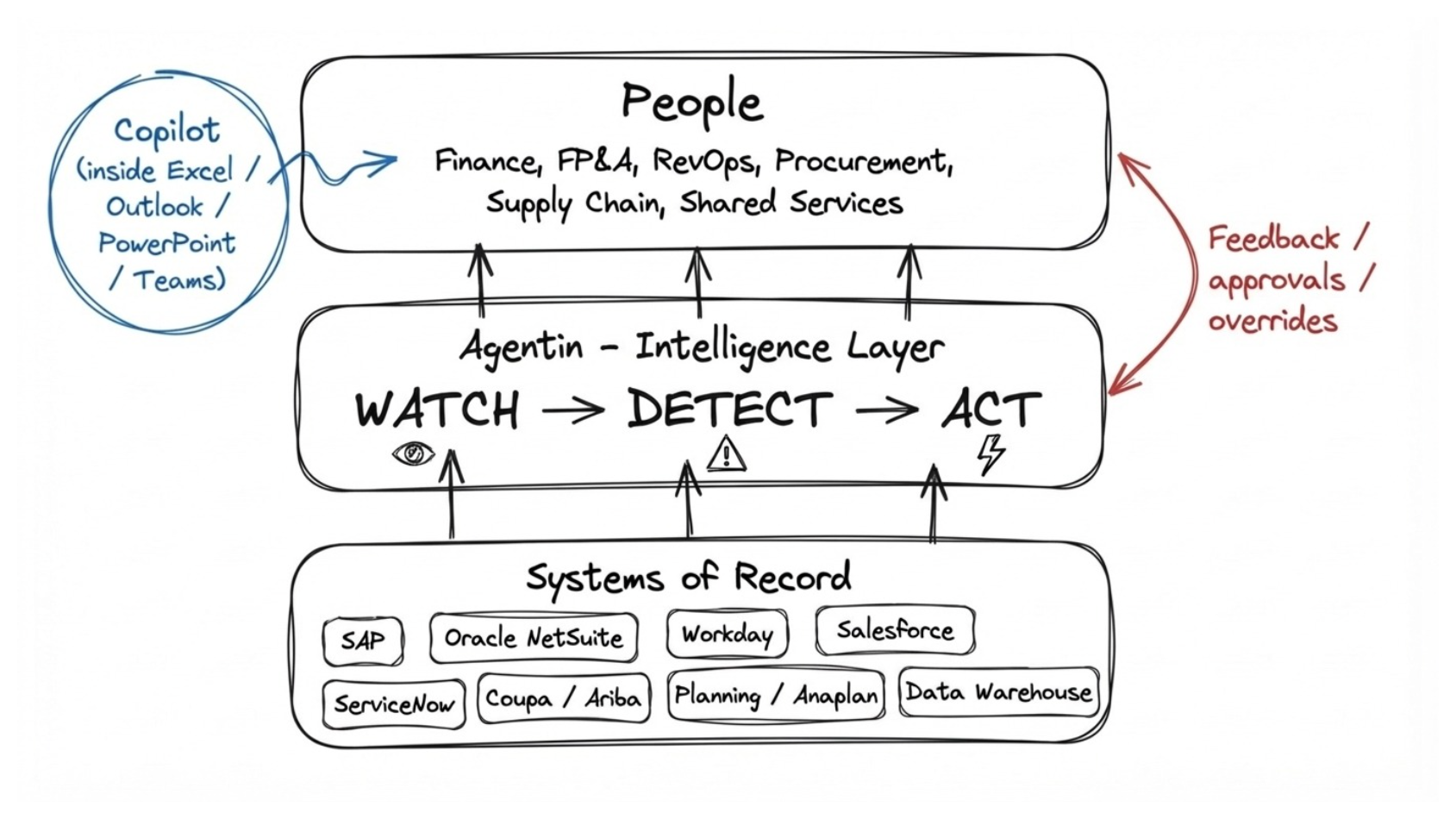
Imagine you had a very strong analyst whose only job was to sit above all your systems and:
- 1. Watch everything important in real time
Orders, POs, invoices, receipts, payments, tickets, approvals, headcount, drivers.Not just in one system, but across SAP / Oracle NetSuite / Workday / Salesforce / procurement / warehouse / data platform. - 2. Understand the workflows those objects belong to
- •This order is part of this contract.
- •This PO is related to this project and this stock.
- •This invoice ties back to that vendor agreement.
- •This variance line is driven by these underlying transactions.
- 3. Notice when something is off
- •This order will blow up revenue recognition.
- •This PO is basically a duplicate of three others.
- •This plant is buying the same material under ten different SKUs.
- •This cost center's variance pattern changed in a way that doesn't match any known driver.
- 4. Propose actions (and sometimes take them)
- •Hold this order and ask for these two fields.
- •Suggest canceling or merging these POs.
- •Route this invoice to the actual person who owns the budget.
- •Post this standard journal for the usual reclass - or at least draft it.
- 5. Learn from feedback
Every time a human approves, edits, or rejects something, they're teaching it. The "tribal knowledge" starts to migrate from mailboxes into the system.
That's what an intelligence layer does.
It's not another dashboard or bot. It's a standing brain over your enterprise software.
Agentin is my attempt to turn that into a product.
A CFO really cares about a few things: not running out of cash, making sure the business is truly profitable, not getting blindsided by bad numbers or broken controls, and closing the books on time with real-time visibility into how healthy the business is.
An intelligence layer helps on all of these: it pulls cash forward by catching stuck money and wasteful working capital, gives real-time visibility into cash and business health so you can forecast liquidity and close the books on time, protects margin by finding leakage in both spend and revenue, and cuts nasty surprises by acting as an always-on control that flags anomalies and broken policies early.
Workflows Are Examples, Not the Whole Story
On our site we talk a lot about Quote-to-Cash and Procure-to-Pay because those are clean, painful entry points.
- •In QTC, you can feel the stupidity of re-typing data from Salesforce to SAP and fixing orders by hand.
- •In P2P, you can see the waste in duplicate POs, missed contract pricing, and pointless approvals.
These are places where the lack of an intelligence layer shows up as obvious delays and errors. So we start there.
But if all we did was "automate QTC and P2P," we'd just be another workflow tool with better marketing.
The point is bigger:
- •QTC is a slice of the company's graph around how revenue moves.
- •P2P is a slice around how spend and materials move.
- •Variance analysis is a slice around how information about all of that gets turned into understanding.
- •Procurement insights (like long-tail SKUs, surplus stock, vendor/price patterns, weird price drift) are a slice where you discover things no one had a clean picture of before.
An intelligence layer should handle all of these:
running workflows, catching errors, surfacing insights, and suggesting structural changes.
QTC and P2P are just the first doors into that graph.
Why This Is Intelligence, Not "Better Automation"
You can feel the difference if you look at the outcome.
Bad "automation" is basically:
"Tell me the steps and I'll blindly repeat them faster."
That's RPA clicking screens, or rigid workflow tools that don't handle exceptions.
An intelligence layer is closer to:
"Show me the system and the outcome you care about.
I'll figure out the patterns, run the routine parts, and bug you only when something really needs a human."
A few concrete differences:
- •Scope
- •Automation: one task or step ("take this invoice PDF and create an AP record").
- •Intelligence: the whole loop ("is this spend justified, in policy, correctly coded, and consistent with what we already know?").
- •Input
- •Automation: explicit rules the human writes.
- •Intelligence: rules + learned patterns + cross-system context.
- •Output
- •Automation: "I did what you told me."
- •Intelligence: "Here's what I did, what I think is weird, and what I think you should change upstream."
The kind of work I care about - surfacing non-obvious patterns on SAP and other systems (surplus stock, long-tail vendors, unstable SKUs, strange price drift) - is exactly in this category. That's not data entry. That's discovering structure in the system that nobody had time to unfold.
The goal is simple: compress the complexity of the enterprise into something the company can actually see and act on.
Variance Analysis as a Small Example
Variance analysis is a simple way to see the difference, because every finance org does it, and everyone hates it.
Today:
- •Actuals from ERP, plan from planning, headcount from HR, POs/invoices from procurement, drivers from CRM/warehouse.
- •A human glues all of this into a spreadsheet.
- •They chase people for explanations.
- •They write a narrative and move on.
- •Most of that knowledge dies at month-end.
Copilot can help a bit in the middle:
- •"Highlight biggest variances."
- •"Draft commentary for these lines."
- •"Turn this into slides."
An intelligence layer treats variance as just another flow:
- •It watches transactions and balances all month, not just at close.
- •It detects unusual patterns versus plan, history, seasonality, and known drivers.
- •It groups variances into meaningful buckets (price, volume, mix, timing, one-off events).
- •It remembers prior explanations and uses them as priors.
- •It links explanations to upstream objects (vendors, contracts, SKUs, customers, campaigns) so you can fix causes instead of rewriting the same story every month.
- •It can even trigger actions when certain patterns show up (investigate this vendor, tighten this policy, change this approval path).
Variance is not "a better pivot table." It's a lens on how the whole system behaves.
An intelligence layer treats it that way.
So Where Does Agentin Sit, Really?
If you draw your stack like this:
- •Systems of record: SAP, NetSuite, Oracle, Workday, Salesforce, ServiceNow, procurement, planning, data warehouse.
- •Tools around them: Excel, Power BI, Tableau, Copilot, notebooks, BI, etc.
- •People above that: finance, operations, procurement, supply chain, FP&A.
Agentin aims to be the missing band between systems and people:
- •We plug into your core systems via APIs.
- •Our agents watch the flows you care about (QTC, P2P, variance loops, collections, procurement patterns, and more).
- •They detect problems and patterns across systems.
- •They act by proposing or taking changes, with full logging and human control.
- •Over time, they learn from how your team actually resolves things.
Quote-to-Cash and Procure-to-Pay are the first places we've proven this works: we have pilots where agents cut cycle times, error rates, and manual touches by large factors. Variance, procurement insight, and other flows sit on the same spine.
If you've already bought Copilot and a data lake and you still feel like your smartest people are acting as duct tape between systems, nothing is wrong with them.
You're just missing the layer that was never there.
Copilot can make the duct tape prettier.
An intelligence layer can start to remove it.
That second thing is what I want Agentin to be.